
"How much do I actually need to bring to closing?" is one of the most common questions I get from buyers relocating from New Jersey and New York — and it's almost always a bigger number than they expect.
Florida structures closing costs differently than most Northeast states, with specific state-mandated taxes that simply don't exist up north. Here's the complete, line-item breakdown.
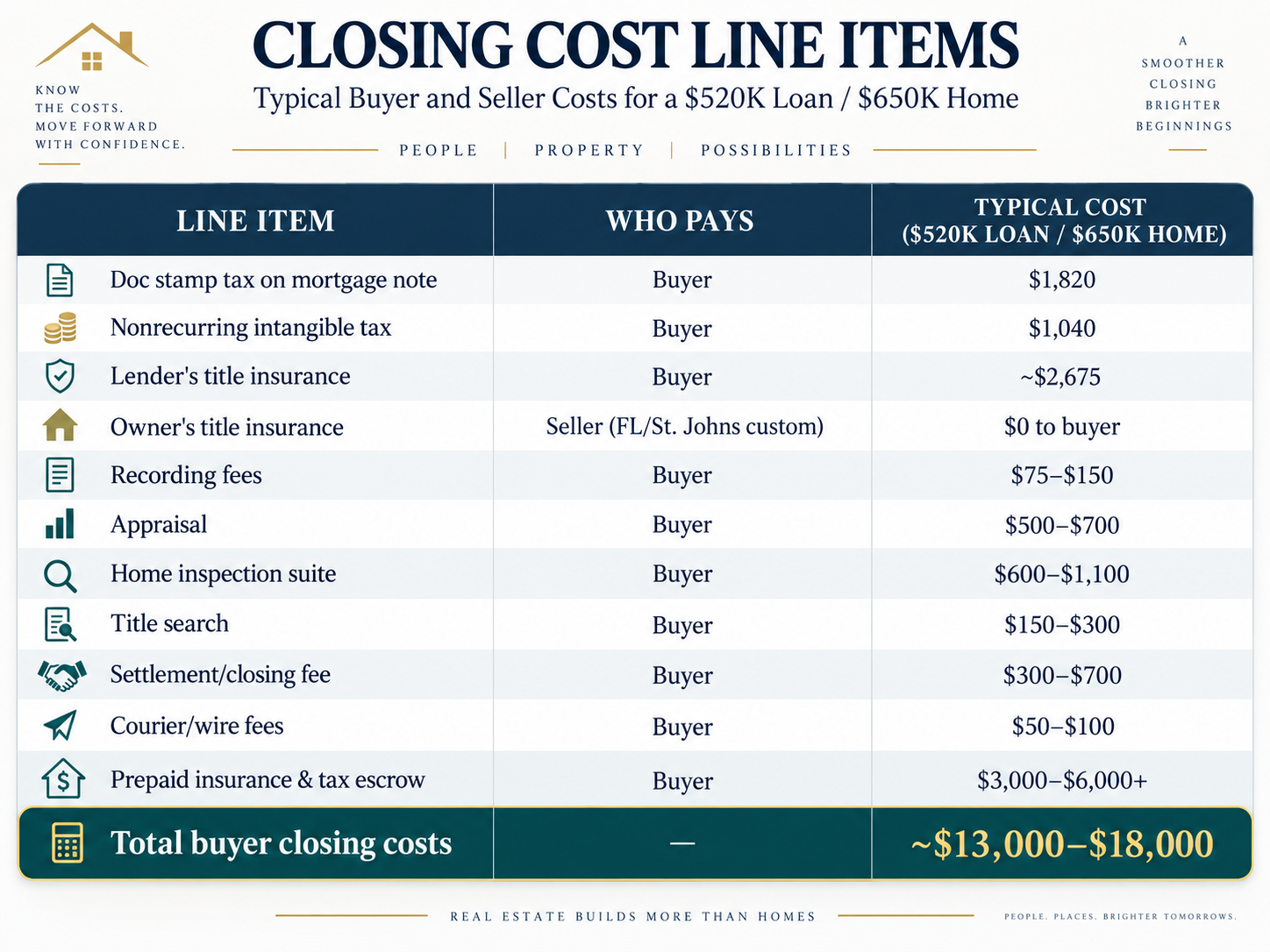
Florida buyers in St. Johns County typically pay 2–4% of the purchase price in closing costs, separate from their down payment. On a $650,000 purchase with 20% down ($130,000), expect $13,000–$18,000 in total closing costs on top of that down payment.
Every Line Item, Explained
1. Documentary Stamp Tax on the Mortgage Note (Buyer Pays)
Florida charges a state tax on your mortgage promissory note — $0.35 per $100 of your loan amount, or $3.50 per $1,000. On a $520,000 loan (80% of a $650,000 purchase), that's $1,820.
2. Nonrecurring Intangible Tax (Buyer Pays)
A one-time state tax on new mortgages: $0.002 per $1, or $2 per $1,000 of loan amount (0.20%). On that same $520,000 loan: $1,040.
3. Lender's Title Insurance (Buyer Pays)
Protects your lender against title defects. Florida uses a state-promulgated rate: $5.75 per $1,000 for the first $100,000, then $5.00 per $1,000 above that. On a $520,000 loan, that runs roughly $2,675.
4. Owner's Title Insurance
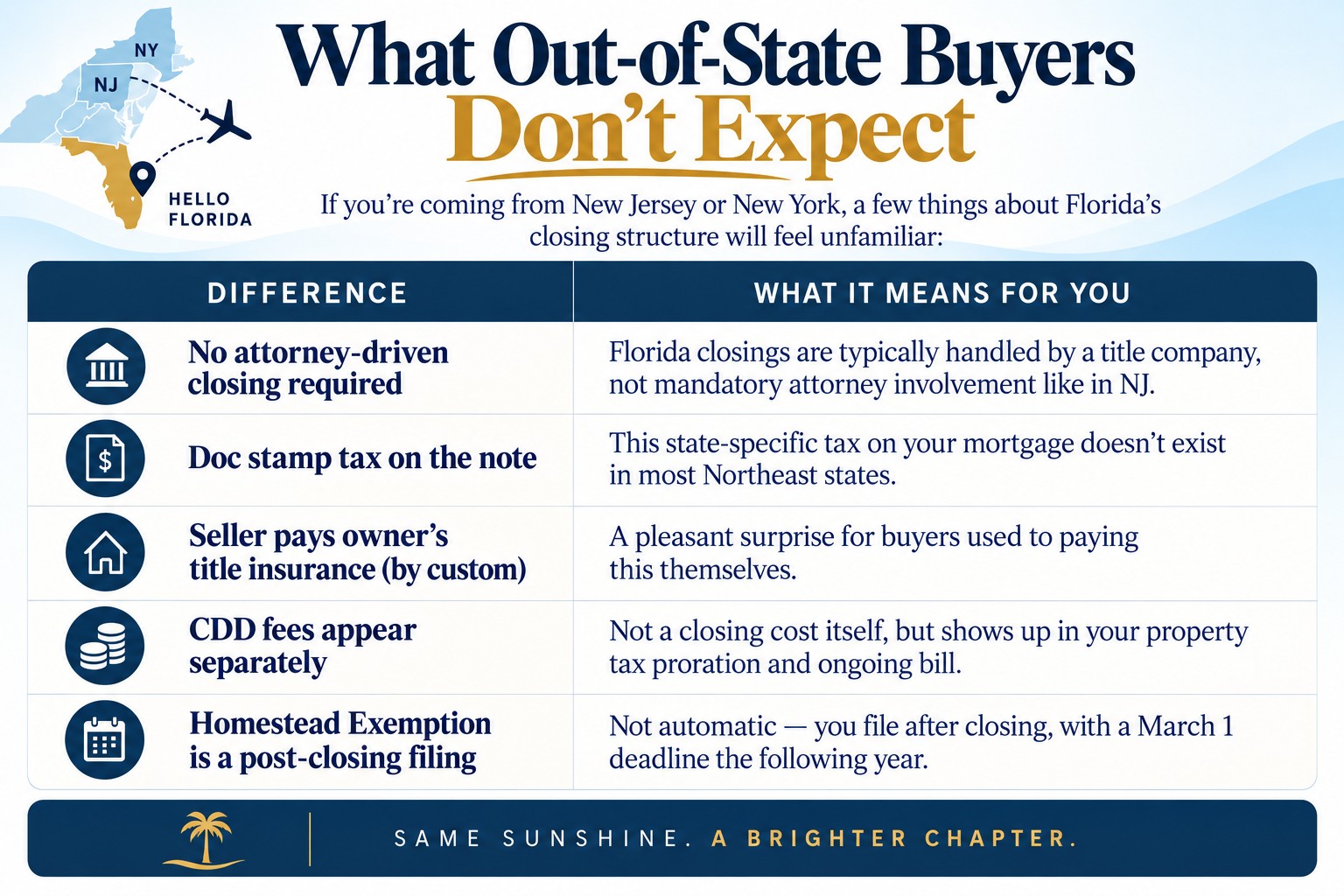
This one depends entirely on custom, and it's where out-of-state buyers get surprised. In St. Johns County — like most of Florida outside Miami-Dade, Broward, Sarasota, and Collier — the seller customarily pays for the buyer's owner's title insurance policy. This is a real relief for buyers, since owner's title insurance can run $2,000–$4,000+ depending on price. Confirm this is reflected in your contract, since it's technically negotiable even though the custom is well-established.
5. Recording Fees (Buyer Pays)
The county charges to record your deed and mortgage: $10 for the first page, $8.50 for each additional page under state statute — typically around $75–$150 total depending on document length.
6. Appraisal (Buyer Pays)
Required by most lenders: $500–$700.
7. Home Inspection (Buyer Pays)
Not legally required but essential — general inspection alone runs $350–$600, with additional Florida-specific inspections (wind mitigation, four-point, WDO) adding another $250–$500.
8. Title Search (Typically Buyer's Lender Requires)
The title company researches the property's history to confirm clear title: $150–$300.
9. Settlement/Closing Fee
Administrative charges for document preparation and coordinating the closing: $300–$700 depending on complexity.
10. Courier/Wire Fees
Minor charges for document delivery and fund transfers: $50–$100 combined.
11. Prepaid Items (Escrow Setup)
Your first year of homeowners insurance and several months of property tax get collected upfront into escrow — this varies enormously by home value and insurance quote, often $3,000–$6,000+ depending on your specific insurance premium and closing date within the tax year.
New Construction Is Genuinely Different — and More Expensive at Closing
This catches almost every out-of-state buyer off guard: on new construction, builders frequently shift costs onto the buyer that a resale seller would normally cover.
On a new build, you'll typically pay Florida documentary stamp taxes on the deed and doc stamps on your mortgage note, intangible tax, and owner's title insurance — where a resale purchase would have the seller absorbing the deed doc stamps and owner's title policy under standard Florida custom.
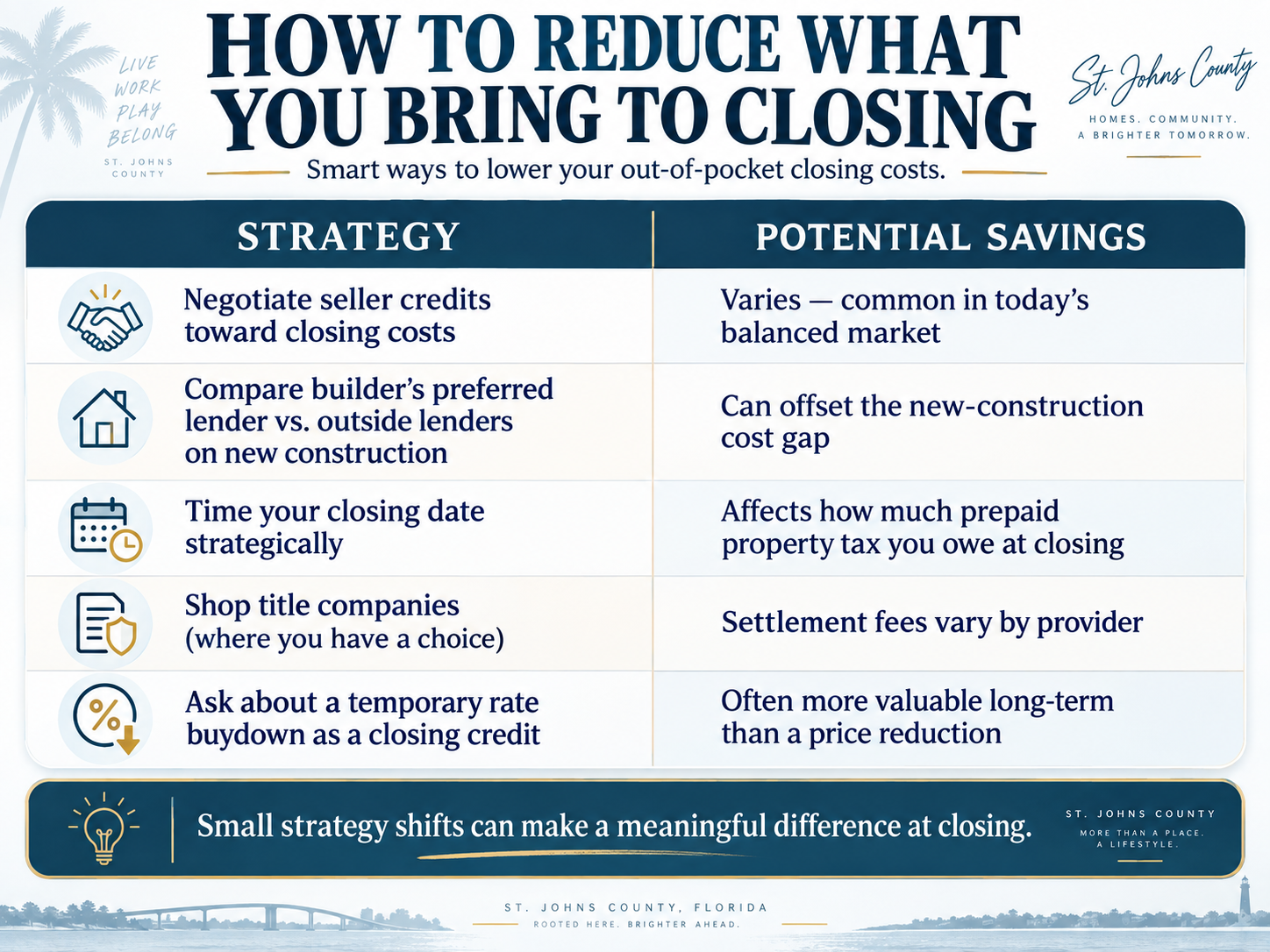
That shift alone — owner's title insurance plus deed doc stamps landing on the buyer instead of the seller — adds roughly $7,875 to your closing costs compared to buying resale on a comparable-priced home. Many builders offer closing cost incentives specifically to offset this if you use their preferred lender — just make sure you're comparing the full picture (rate, terms, and incentive) before committing.
Don't Forget: What Happens After Closing
Once you close on your primary residence in St. Johns County, you become eligible for Florida's Homestead Exemption — up to $51,411 in assessed value reduction for the 2026 tax year. This isn't a closing cost, but it's the single most important follow-up step, and it directly reduces your property tax bill starting the following tax year if filed by the March 1 deadline.
The Bottom Line
Plan on 2–4% of your purchase price in closing costs beyond your down payment — and budget closer to the higher end if you're buying new construction, where the standard Florida custom of seller-paid title insurance and deed doc stamps typically shifts onto you instead. On a $650,000 home, that's realistically $13,000–$18,000 for resale, or meaningfully more for new construction without a strong incentive package.
None of this should be a surprise on closing day — and with the right preparation, it isn't.
Want a Personalized Closing Cost Estimate?
I can walk you through the exact numbers for any specific property you're considering — resale or new construction — before you ever sign a contract.
Call or text Gail DeMarco: 904-640-8000
St. Johns County Relocation Specialist
Serving Nocatee, SilverLeaf, RiverTown, Del Webb Saint Johns, and all of St. Johns County, FL
Figures reflect 2026 Florida statutory rates and St. Johns County customs as reported by local title and real estate sources. Individual closing costs vary by lender, transaction, and negotiation. This article is for informational purposes only and does not constitute legal or financial advice — consult a licensed Florida title company or real estate attorney for transaction-specific figures.