


.png)
If you're considering moving to St. Johns County, Florida, one of the biggest questions is simple:
"How much does it really cost to live here?"
The answer depends heavily on your housing choice, family size, insurance costs, transportation, and lifestyle.
St. Johns County isn't one of Florida's bargain-priced areas, but many buyers are attracted by its quality of life, strong communities, beaches, schools, and access to Jacksonville and St. Augustine.
Here's a realistic look at the numbers for 2026.
What Does It Cost to Live in St. Johns County?
The MIT Living Wage Calculator, updated February 2026, estimates that a single adult in St. Johns County needs approximately $53,826 in annual income before taxes to cover basic living expenses.
For a household with two adults and two children, with both adults working, MIT estimates approximately $127,012 in annual pre-tax income to cover basic needs.
These are basic-needs estimates—not luxury budgets. Your actual costs can be much higher depending on the home you choose and your lifestyle.
What Are the Biggest Expenses?
For a single adult, MIT's 2026 St. Johns County estimates include approximately:
| Expense | Annual Estimate |
|---|---|
| Housing | $19,758 |
| Transportation | $9,519 |
| Food | $5,071 |
| Medical | $3,128 |
| Internet & Mobile | $1,581 |
| Other necessities | $4,067 |
| Civic expenses | $2,583 |
MIT's estimated annual basic expenses total about $45,707 after taxes, before accounting for taxes needed to reach that income.
Housing Is the Biggest Variable
This is where your St. Johns County budget can change dramatically.
As of May 2026, Redfin reported a countywide median home sale price of approximately $513,460, with homes selling in a median of 64 days.
But the county includes everything from more affordable inland neighborhoods to higher-priced areas near Nocatee, Ponte Vedra Beach, and St. Augustine.
Your monthly housing cost may include:
- Mortgage principal and interest
- Property taxes
- Homeowners insurance
- HOA fees
- CDD fees, where applicable
- Flood insurance, if needed
- Maintenance and repairs
This is why two households earning the same income can have completely different monthly budgets.
Sample 2026 Monthly Budgets
These aren't official cost-of-living averages. They're simple planning examples based on the major expense categories identified by MIT and typical homeownership expenses that buyers should consider.
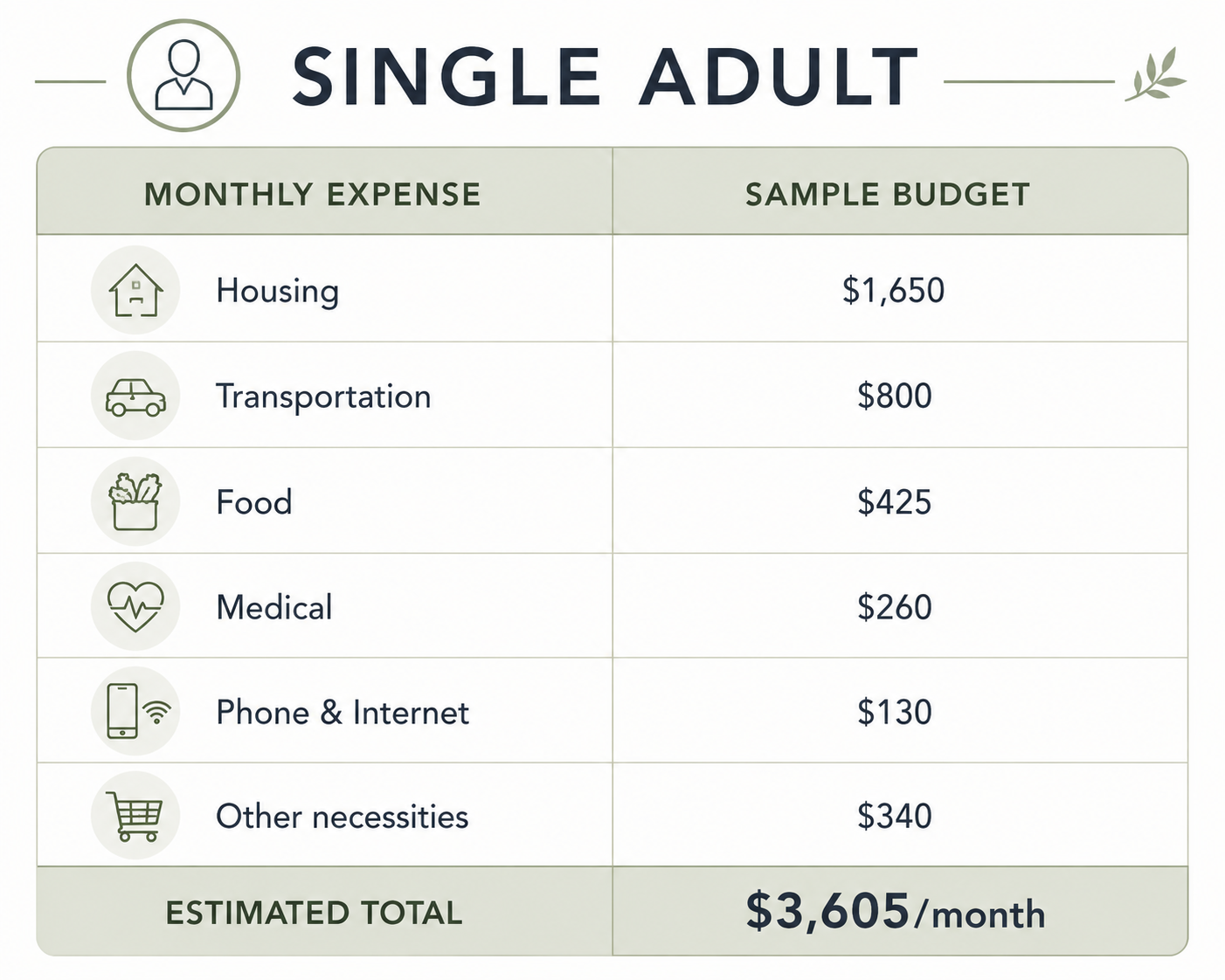
Couple With No Children
A couple can benefit from sharing housing and some household expenses, but transportation, healthcare, insurance, and lifestyle choices can still add up quickly.
A reasonable starting point is approximately $4,500–$5,500+ per month, depending heavily on housing costs.
Family With Two Children
For a family of four, MIT's 2026 model estimates $127,012 in annual pre-tax income for two working adults to cover basic needs. Childcare is a major variable: MIT estimates about $28,680 per year for two children in its St. Johns County model.
Families who don't have childcare expenses may therefore have a significantly different budget.
What Makes St. Johns County More Expensive?
For relocating buyers, there are several costs worth planning for:
Housing
The county's median sale price was about $513,000 in May 2026, although prices vary substantially by community.
Homeowners Insurance
Florida insurance can be considerably higher than what many Northeast buyers are accustomed to paying. Get an insurance quote before you commit to a property.
Transportation
St. Johns County is primarily car-oriented, so most households should budget for vehicle payments, fuel, insurance, maintenance, and registration.
HOA & CDD Fees
Many master-planned communities have HOA fees, and some neighborhoods also have CDD assessments. These costs can differ significantly even between nearby communities.
One Major Florida Financial Advantage
Florida has no individual state income tax, which can be particularly meaningful for households relocating from states such as New York, New Jersey, or Connecticut.
But don't make the mistake of assuming "no state income tax" automatically means everything is cheaper.
Housing, insurance, transportation, and other expenses still matter.
The better question is: What will my total monthly cost of living look like after I move?
So, How Much Do You Need?
A simple starting point for 2026 planning:
| Household | MIT Estimated Pre-Tax Income for Basic Needs |
| 1 adult, no children | $53,826/year |
| 2 adults, 1 working, no children | $70,247/year |
| 2 adults, both working, 2 children | $127,012/year |
These numbers are useful benchmarks—but they aren't a recommended income level for buying a home in St. Johns County. A household purchasing a $500,000+ home will need to build a much more personalized budget around its mortgage, down payment, taxes, insurance, HOA/CDD fees, and other expenses.
The Bottom Line
The real cost of living in St. Johns County depends less on the county itself and more on the lifestyle and home you choose.
For 2026, the numbers show that St. Johns County is not necessarily a low-cost destination—but it can offer a compelling combination of Florida's tax structure, strong communities, outdoor lifestyle, beaches, and access to Jacksonville and St. Augustine.
If you're relocating from the Northeast, don't compare home prices alone.
Compare your total monthly cost of living—housing, insurance, taxes, transportation, utilities, and everyday expenses.
That's where you'll see whether the move actually makes financial sense for you.
Thinking About Moving to St. Johns County?
Call or text Gail DeMarco at 904-640-8000 for help comparing neighborhoods, home prices, HOA/CDD costs, insurance considerations, and the overall cost of living in communities throughout St. Johns County.
Data note: MIT Living Wage figures were updated February 15, 2026. Housing market figures reflect May 2026 data reported by Redfin. Sample budgets are illustrative planning examples and are not quotes or guarantees. Actual costs vary based on household size, property, insurance, taxes, lifestyle, and other individual circumstances.