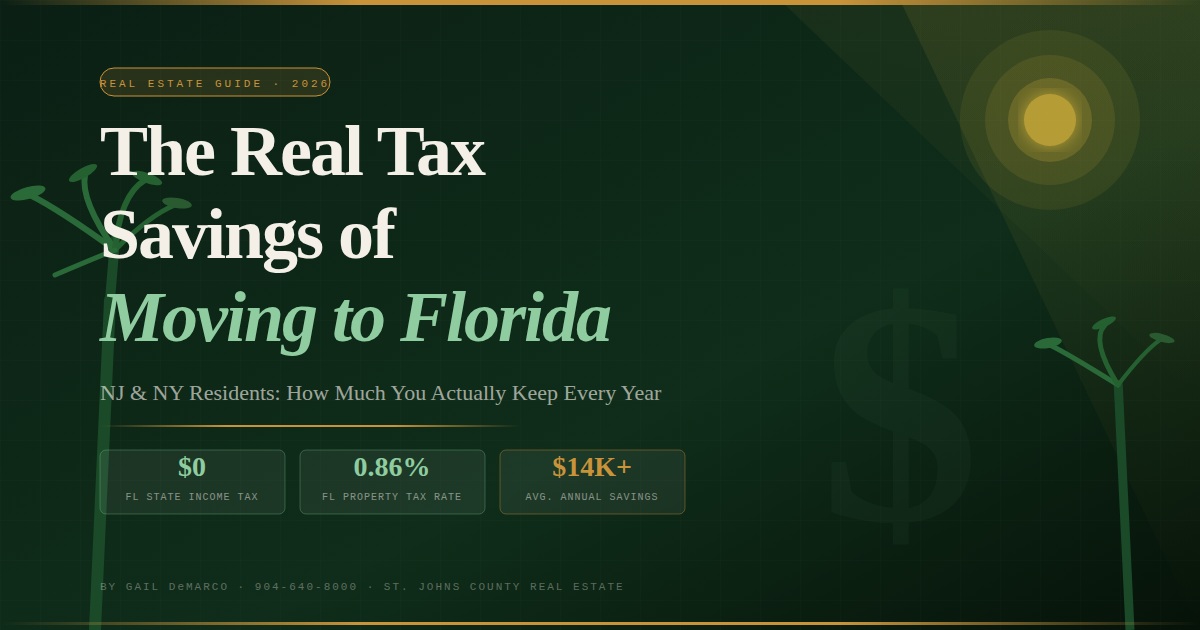
Nobody likes talking about taxes. But when a single relocation decision can put $8,000 to $12,000 — or more — back in your pocket every single year, it becomes one of the most important financial conversations you can have.
If you live in New Jersey or New York and you've been thinking about moving to St. Johns County, Florida, this post is your wake-up call. Not a vague promise about "Florida's tax advantages." Real numbers. Real line items. A real calculation you can run against your own situation tonight.
Let's get into it.
The Foundation: Florida Has No State Income Tax
This is the headline — and it deserves to be stated plainly before anything else.
Florida is one of only nine states in the country with no state income tax. Zero. None. Your wages, your salary, your freelance income, your consulting fees — none of it is taxed at the state level in Florida.
New Jersey's state income tax rate goes up to 10.75% — the second highest in the United States.
New York's state income tax rate goes up to 10.9%. Add New York City's local income tax of up to 3.876% if you live in the five boroughs, and city residents can face a combined state and local income tax rate approaching 14.776%.
That is not a typo. Nearly 15 cents of every dollar earned goes to New York State and New York City before federal taxes even enter the picture.
The moment you establish Florida residency — and domicile your life in St. Johns County — that state and local income tax burden drops to zero. Permanently.
The Simple Calculator: A $120,000 Household
Let's make this concrete. Meet a household earning $120,000 per year — a dual-income couple, a mid-career professional, or a retiree drawing from a pension and investment accounts. Here's what their tax picture looks like in each state versus St. Johns County, Florida.
State Income Tax
- New Jersey ($120K income): New Jersey taxes this income across graduated brackets. A household earning $120,000 in NJ pays approximately $5,200–$6,800 in state income tax annually depending on filing status and deductions.
- New York ($120K income): New York State income tax on $120,000: approximately $6,100–$7,400. Add NYC local tax if applicable: approximately $3,200–$4,000 more. Total state plus local for NYC residents: $9,300–$11,400 per year.
- St. Johns County, FL ($120K income): State income tax: $0. Local income tax: $0. Annual income tax savings versus NJ: $5,200–$6,800. Annual income tax savings versus NYC: $9,300–$11,400.
Property Taxes
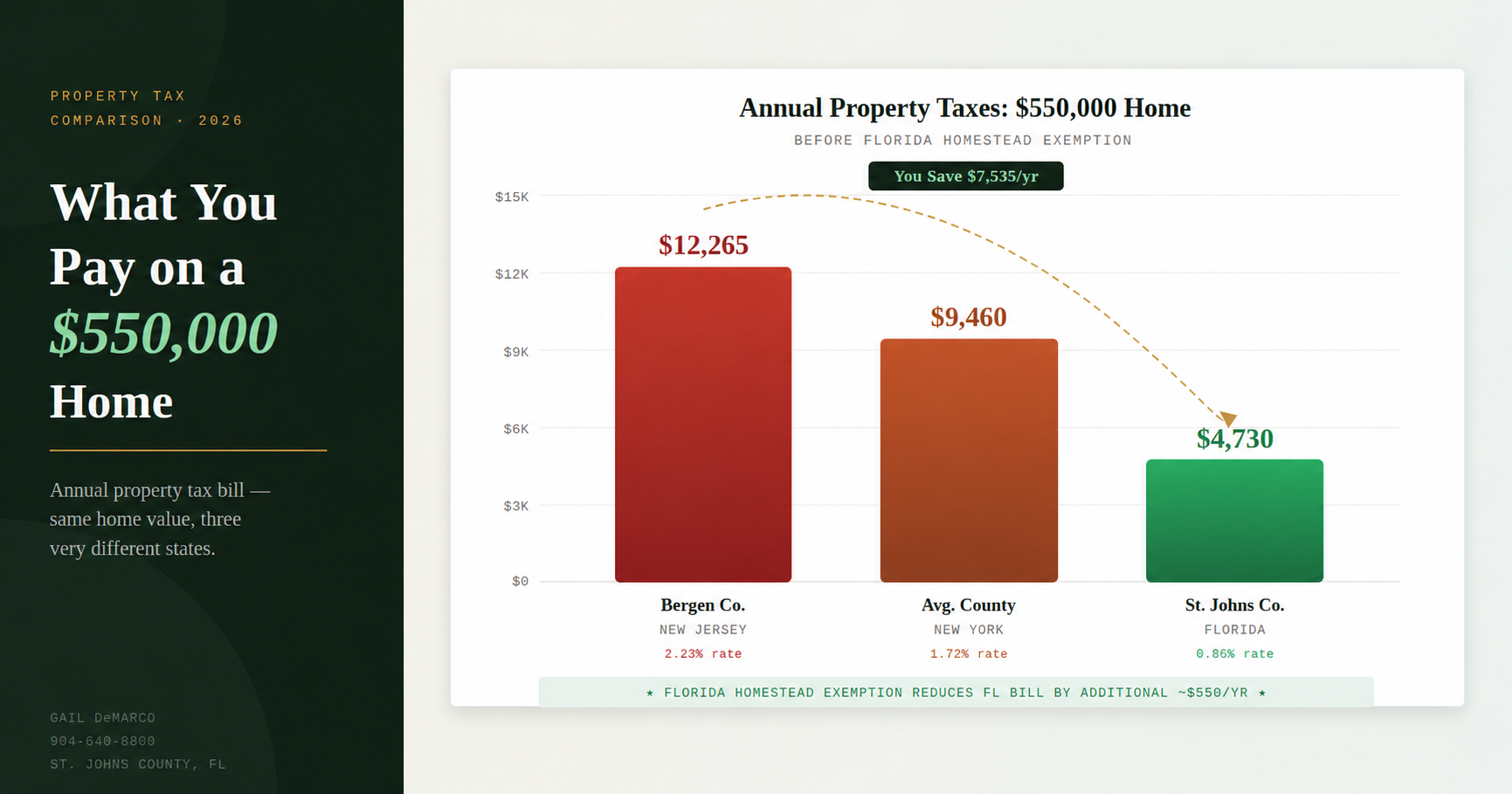
- New Jersey (on a $550,000 home): At New Jersey's average effective property tax rate of 2.23%, annual property taxes: approximately $12,265.
- New York (on a $550,000 home outside NYC): At New York's average effective property tax rate of 1.72%, annual property taxes: approximately $9,460.
- St. Johns County, FL (on a $550,000 home): At Florida's average effective property tax rate of 0.86%, annual property taxes before exemptions: approximately $4,730. After the Florida Homestead Exemption ($50,000 off assessed value): approximately $4,300.
Annual property tax savings versus NJ: $7,965. Annual property tax savings versus NY: $5,160.
The $120K Household Running Total
NJ resident moving to St. Johns County: Income tax savings: $6,000 Property tax savings: $7,965 Total annual savings: approximately $13,965
NY/NYC resident moving to St. Johns County: Income tax savings: $10,350 Property tax savings: $5,160 Total annual savings: approximately $15,510
NY State resident (outside NYC) moving to St. Johns County: Income tax savings: $6,750 Property tax savings: $5,160 Total annual savings: approximately $11,910
Every one of these scenarios lands solidly in the $8,000–$15,000 annual savings range — and we haven't touched retirement income, investment income, or estate planning yet.
Florida's Homestead Exemption: What It Is and How It Works
Once you purchase a primary residence in Florida and establish it as your homestead, you qualify for the Florida Homestead Exemption — one of the most valuable property tax benefits in the country.
Here's exactly what it does:
The first $25,000 of your home's assessed value is completely exempt from all property taxes. The next $25,000 (assessed value from $25,001 to $50,000) is exempt from all taxes except school district taxes. In practice, this reduces your taxable assessed value by up to $50,000 — saving the average St. Johns County homeowner approximately $500–$700 per year on their tax bill compared to a non-homesteaded property.
To qualify, the property must be your permanent primary residence as of January 1st of the tax year. You must apply through the St. Johns County Property Appraiser's office by March 1st of the year you're claiming the exemption.
This is not automatic. It requires an application. One of the first calls I tell every buyer to make after closing is to the Property Appraiser's office to file their homestead exemption.
The Save Our Homes Cap: Your Protection Against Future Tax Spikes
This is the benefit that New Jersey and New York homeowners understand most viscerally — because they've lived without it.
In NJ and NY, your property tax bill can increase dramatically year over year as municipal budgets grow, assessments are updated, and local governments raise rates. There is no meaningful limit on how fast your property tax bill can climb. Many long-term NJ homeowners have watched their annual property tax bill increase by $1,000–$3,000 in a single reassessment cycle.
Florida has the Save Our Homes cap — and it changes everything.
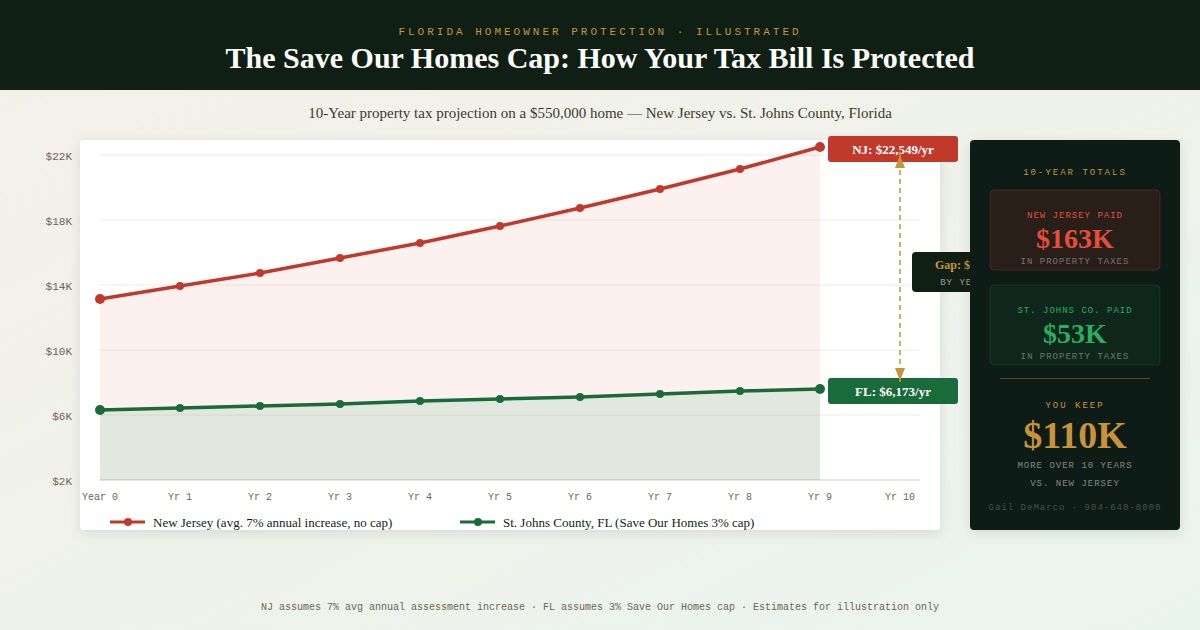
Once you file a Homestead Exemption on your Florida primary residence, the Save Our Homes cap limits the annual increase in your property's assessed value to 3% or the rate of inflation — whichever is lower. Every year. Permanently, as long as you maintain homestead status.
This means that even if the real estate market surges and your home's market value increases by 15% in a year, your taxable assessed value can only go up by 3% maximum. Your property tax bill is structurally protected from the kind of runaway increases that have driven so many New Jersey and New York homeowners out of their homes.
Over a 10-year homeownership period in a rising market, the Save Our Homes cap can easily save a St. Johns County homeowner $15,000–$40,000 in cumulative property taxes compared to what they would have paid without the cap. That is money that stays in your family — not in a municipal budget.
Portability: Florida also allows you to take your accumulated Save Our Homes savings — called "portability" — with you when you move to another Florida home. If you've built up significant protected value in your first Florida home and decide to upsize or downsize within the state, you don't start from zero. You carry up to $500,000 of that protected assessment difference to your new home. This is a powerful long-term benefit that compounds over time.
Taxes on Retirement Income: Where Florida Wins Completely
For retirees or near-retirees moving from New Jersey or New York, the income tax picture gets even more favorable — because Florida doesn't just spare your wages. It spares everything.
- Social Security income: New Jersey: partially taxed for higher-income households. New York: partially taxed at the state level. Florida: completely exempt. $0 in state tax on Social Security. Ever.
- Pension income: New Jersey: fully taxed as ordinary income at state rates. New York: partially taxed (some government pensions exempt, private pensions taxed). Florida: completely exempt. $0 in state tax on pension income.
- IRA and 401(k) distributions: New Jersey: taxed as ordinary income. New York: taxed as ordinary income (some pension exclusions apply). Florida: $0 in state tax on retirement account distributions.
- Investment income (dividends, capital gains): New Jersey: taxed at state income tax rates. New York: taxed as ordinary income at state rates. Florida: $0 in state tax on investment income.
For a retired couple drawing $95,000 per year from a combination of Social Security, pension, and IRA distributions — which is a typical picture for a retiring NJ or NY professional — the annual state income tax savings in Florida range from $3,500 to $8,500 depending on their prior state and income composition.
Over a 20-year retirement, that differential compounds to $70,000–$170,000. Before investment growth. Before the property tax savings. Before the Homestead Exemption and Save Our Homes cap.
The cumulative lifetime tax advantage of retiring in Florida versus New Jersey or New York is, for most households, a six-figure number. Often well into the six figures.
Estate and Inheritance Tax: The Benefit Nobody Talks About Until It's Too Late
This is the category that catches the most people off guard — because estate and inheritance taxes aren't something most families think about until they're deep into retirement planning or dealing with a loss.
- New Jersey: NJ abolished its state estate tax in 2018, but it still imposes a state inheritance tax on assets left to certain beneficiaries. Siblings, nieces, nephews, and non-family members can face NJ inheritance tax rates up to 16%. If you have a complex family situation or plan to leave assets to anyone other than a spouse or direct descendants, New Jersey's inheritance tax is a real planning concern.
- New York: New York imposes a state estate tax with an exemption of approximately $7.16 million (2026). Estates above that threshold are taxed at rates up to 16%. New York also has a notorious "cliff effect" — if your estate exceeds the exemption by even a small amount, the entire estate above zero becomes taxable, not just the excess. For high-net-worth households, this is a significant planning issue.
- Florida: No state estate tax. No state inheritance tax. None. Assets pass to your heirs without any Florida state-level death tax, regardless of the size of your estate or who your beneficiaries are.
For families with meaningful accumulated wealth — a combination of real estate equity, retirement accounts, investment portfolios, and business interests — establishing Florida domicile before death can preserve hundreds of thousands of dollars in state-level death taxes for the next generation.
This is not a fringe benefit. For households with estates above $1–2 million, it is one of the most significant financial advantages of Florida residency.
Domicile Matters: How to Make the Tax Benefits Stick
Here's something most articles skip — and it's important.
Simply buying a home in Florida does not automatically make you a Florida resident for tax purposes. New Jersey and New York are aggressive about auditing former residents who claim to have moved but maintain significant ties to the original state. NJ and NY have been known to pursue tax claims against former residents for years after a stated relocation — and they win those cases when the former resident hasn't properly established Florida domicile.
To properly establish Florida domicile and protect your tax benefits, you need to take deliberate steps including:
Obtain a Florida driver's license and surrender your NJ or NY license. Register your vehicles in Florida. Register to vote in Florida. File a Florida Declaration of Domicile with your county clerk. Update your estate planning documents — will, trust, power of attorney — to reflect Florida domicile. Spend the majority of your time (183+ days per year) in Florida. Update your address on bank accounts, brokerage accounts, insurance policies, and with the IRS. Resign from any NJ or NY professional or civic organizations where membership implies primary residence.
This is not complicated, but it is deliberate. I always recommend working with a Florida-based estate attorney and CPA in the year of your move to make sure your domicile change is properly documented and bulletproof.
The Full Annual Savings Picture: $120K Household Summary
Let's bring it all together for a household earning $120,000 moving from New Jersey to St. Johns County, Florida:
State income tax savings: $6,000/year Property tax savings (NJ vs. FL on comparable homes): $7,965/year Homestead Exemption additional savings: $600/year Save Our Homes cap (estimated value in year 3+): $800–$2,000/year Retirement income tax savings (if applicable): $3,500–$6,000/year
Conservative annual total for a working household: $14,565/year Annual total for a retired household drawing $95K: $18,000–$22,000/year
Over 10 years for a working household: $145,650 in cumulative tax savings Over 20 years for a retired couple: $360,000–$440,000 in cumulative tax savings
These are not projections built on best-case assumptions. These are conservative estimates based on actual current tax rates, actual current property tax data, and actual Florida exemption values.
The money is real. The savings are real. And for most households, the only variable is how soon they decide to act on them.
One More Number to Leave You With
New Jersey has the highest property tax burden of any state in America. New York City residents pay a combined state and local income tax rate that is among the highest of any jurisdiction in the developed world.
Florida has no income tax, no estate tax, no inheritance tax, a capped property tax assessment system, and one of the most generous homestead exemption programs in the country.
You have been subsidizing one of the most expensive tax environments in America. St. Johns County is offering you a way out — with world-class schools, resort-style communities, and a lifestyle that most people only get to experience on vacation.
The math has never been more obvious. The only question is what you're waiting for.
Want a Personalized Tax Savings Estimate for Your Situation?
Every household is different. Your income sources, your home value, your retirement timeline, and your estate planning picture all affect what the move actually saves you. I work with relocating families and retirees from New Jersey and New York every week — and I can connect you with the right local CPA and estate attorney to run the real numbers for your household.
No pressure. No sales pitch. Just clarity — and a clear path forward.
Call or text Gail DeMarco: 904-640-8000
St. Johns County Relocation and Tax Savings Specialist Serving Nocatee, Ponte Vedra, St. Johns, St. Augustine, and all of St. Johns County, FL
Disclaimer: Tax figures cited are estimates based on 2025–2026 federal and state tax data. Individual tax situations vary based on income sources, filing status, deductions, and other factors. This article is for informational purposes only and does not constitute legal, financial, or tax advice. Always consult a qualified CPA and estate attorney for guidance specific to your household.