.png)
You found the perfect home in Nocatee, Del Webb Saint Johns, or RiverTown. The price is right. The community is beautiful. The amenities blew you away. And then you looked at the full cost breakdown and saw a line item you've never seen before in your life:
CDD Fee: $2,200/year.
If you're moving from New Jersey, New York, Connecticut, or anywhere outside of Florida, your first reaction was probably one of three things: confusion, suspicion, or a quick Google search that left you more confused than when you started.
You're not alone. "What is a CDD fee in Florida?" is one of the most searched real estate questions from relocating buyers — and it deserves a clear, honest, no-jargon answer.
Here it is.
The Simple Answer
A CDD fee (Community Development District fee) is your share of paying for the infrastructure and amenities in your community—things like roads, utilities, and amenity centers.
It shows up on your annual property tax bill, not as a monthly fee.
Why It Exists
Building a master-planned community from raw land is expensive. Roads, drainage, clubhouses, pools, and parks can cost tens of millions.
Instead of rolling all of that into the home price, Florida allows developers to finance it through bonds. Homeowners then repay that cost over time through the CDD fee.
Think of it as spreading out the cost of the lifestyle you’re buying into.
What the CDD Pays For
Depending on the community, your CDD likely funded:
- Roads and utilities
- Clubhouses and amenity centers
- Pools, fitness centers, and courts
- Parks, trails, and green space
- Landscaping and common areas
Without it, you’d either lose these features—or pay a much higher purchase price upfront.
How It’s Paid
Unlike an HOA, your CDD is:
- Paid once a year
- Included in your property tax bill
- Often escrowed into your mortgage
This is why many buyers don’t notice it until later.
How Much Are CDD Fees in St. Johns County?
CDD fees vary by community, by phase within a community, and by lot size or location. Here are approximate ranges for the major communities in St. Johns County as of 2026:
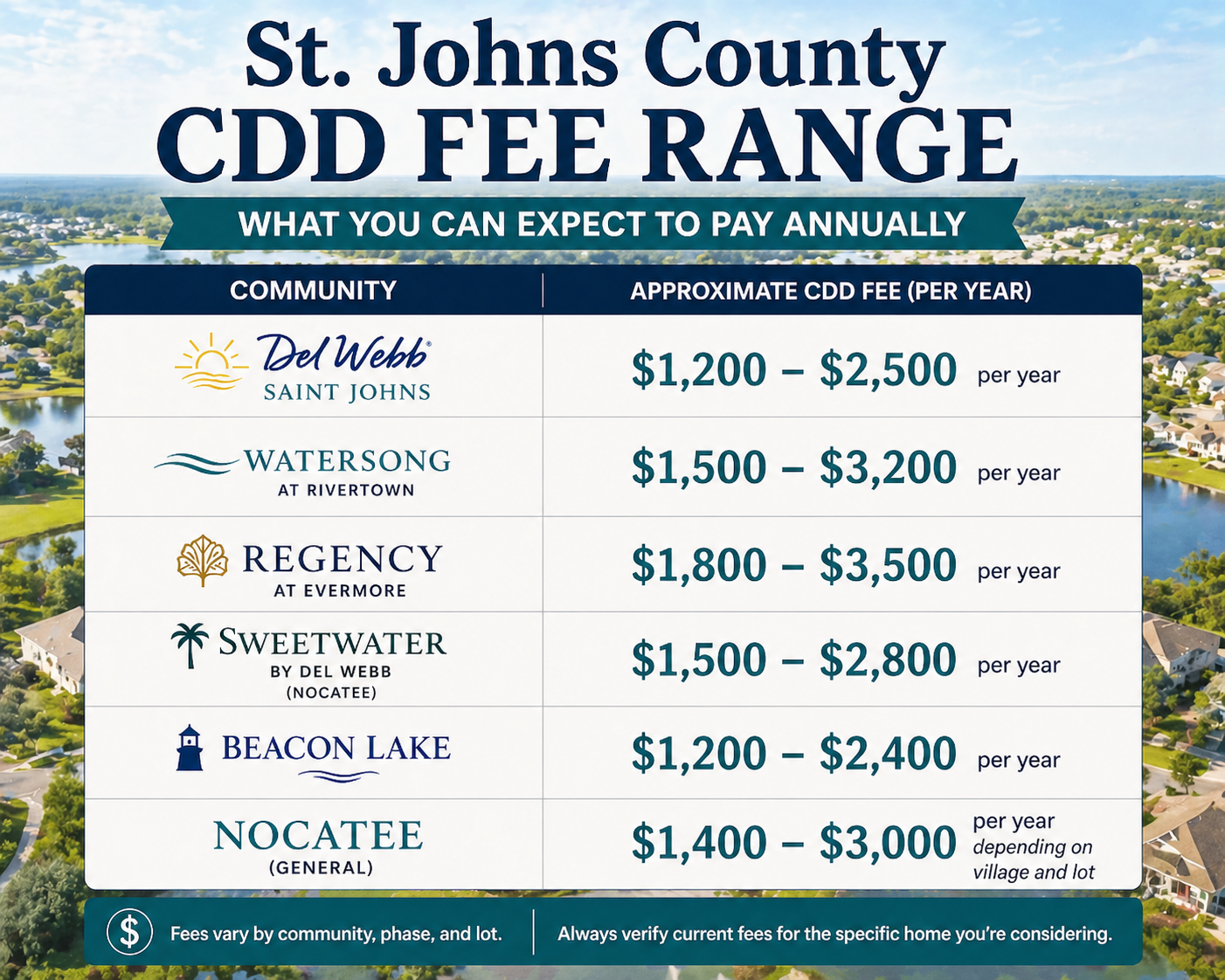
These are estimates. Always ask your real estate agent and the builder's sales team for the exact CDD assessment for the specific lot and phase you are considering. CDD fees can vary significantly even within the same community depending on which phase was built and how much of the bond has already been paid down.
Does the CDD Fee Ever Go Away?
Yes — and this is one of the most misunderstood aspects of CDD fees.
The CDD bond has a fixed repayment term, typically 20 to 30 years. Once the bond is fully retired, the debt service portion of your CDD assessment goes away or drops dramatically. In mature communities where the bond has been paid off, the remaining CDD assessment is often just a small maintenance fee — sometimes as low as a few hundred dollars per year — to cover ongoing upkeep of CDD-funded infrastructure.
This means that if you buy a resale home in an older community where the bond is partially or fully paid down, your CDD fee may be significantly lower than in a brand-new community where the full bond term is just beginning.
Some buyers actually have the option to pay off their portion of the CDD bond in a lump sum at closing — this is called a CDD bond payoff or prepayment. The amount varies but can range from $10,000 to $30,000 or more depending on the community and the outstanding balance. If you plan to stay in the home long-term, a lump-sum payoff can make financial sense. Ask your agent and attorney to run the numbers.
CDD Fee vs. HOA Fee: What's the Difference?
Buyers often confuse these two, so here's a clean side-by-side breakdown:
HOA Fee — paid monthly or quarterly directly to the homeowners association. Covers: ongoing community management, common area maintenance, amenity operations (staffing, programming, utilities), landscaping of shared spaces, and sometimes exterior home maintenance depending on community type. This fee continues indefinitely as long as you own in the community.
CDD Fee — paid annually through your property tax bill to the Community Development District. Covers: repayment of the bond that financed the community's initial infrastructure and amenity construction. This fee has a defined end date tied to the bond term and may decrease or disappear once the bond is retired.
You will pay both in most master-planned communities in St. Johns County. Always add them together — along with your property taxes — when calculating your true annual cost of ownership.
Is the CDD Fee Worth It?
This is the real question. And the honest answer is: for most buyers relocating to St. Johns County from the Northeast, yes — by a significant margin.
Here's why.
When you pay a CDD fee in a community like Nocatee or Del Webb Saint Johns, you are not just paying a line item. You are paying for the use of infrastructure and amenities that would cost you far more to access privately. Resort pools, fitness centers, pickleball courts, walking trails, kayak launches, and clubhouses — these are not cheap to build or maintain. The CDD helped pay for their construction. Your HOA helps maintain them. Together, they deliver an amenity package that a standalone home in any Northeast suburb simply cannot match.
Now compare the total cost:
A $500,000 home in Del Webb Saint Johns carries approximately $260/month in HOA, $1,800/year in CDD, and $4,500/year in property taxes. Your total annual carrying cost beyond your mortgage is roughly $9,420.
A $500,000 home in Bergen County, NJ carries $13,000–$15,000 in property taxes annually with no community amenities, no resort pool, no fitness center, no organized social programming, and no pickleball courts. Your total annual cost is $13,000–$15,000 — for a 1970s colonial with a modest lot.
The CDD community wins on value. Every time.
Five Questions to Ask Before You Buy in a CDD Community
Before you sign a contract on any home in a CDD community, make sure you get clear answers to these five questions:
- One — What is the exact annual CDD assessment for this specific lot? Don't accept a range. Get the number for your lot.
- Two — How many years remain on the CDD bond? The fewer years remaining, the sooner your fee drops or disappears.
- Three — Can I pay off my portion of the CDD bond at closing? If so, what is the payoff amount? Run the math on whether it makes financial sense for your timeline.
- Four — What does the CDD cover in this community versus what the HOA covers? Understanding the division of responsibility helps you evaluate both fees clearly.
- Five — Has the CDD board transitioned to resident control? A resident-controlled CDD board is more responsive to homeowner concerns and typically manages finances more transparently than a developer-controlled board.
The Bottom Line for Out-of-State Buyers
If you're moving to St. Johns County from New Jersey, New York, or any state where CDD fees don't exist, the most important mindset shift is this: stop thinking of it as a mystery tax and start thinking of it as a structured amenity investment with a defined end date.
You moved to Florida in part because of the lifestyle. The CDD helped build that lifestyle. You're paying your share of what made this community possible — and in return, you get a resort-caliber living environment, lower overall taxes than you paid up north, no state income tax, and a daily quality of life that most of your former neighbors would trade for in a heartbeat.
The CDD fee isn't a red flag. In the right community, it's proof that someone built something worth paying for.
Have Questions About CDD Fees in a Specific Community?
I work with buyers every week who are navigating this exact question — and I know the CDD details for every major community in St. Johns County. Whether you're comparing Del Webb Saint Johns to WaterSong at RiverTown, or trying to decide if a lump-sum CDD payoff makes sense for your situation, I can walk you through the real numbers.
Call or text Gail DeMarco: 904-640-8000 St. Johns County's Relocation Specialist Serving Nocatee, Ponte Vedra, St. Johns, St. Augustine, and all of St. Johns County, FL
Disclaimer: CDD fee amounts cited are approximate 2026 estimates and subject to change. Always verify the exact CDD assessment for any specific property with the builder, listing agent, or CDD district office before making a purchase decision. This article is for informational purposes only and does not constitute legal or financial advice.